Introduction
Smart home technology has expanded beyond simple Wi-Fi light bulbs and smart plugs. Modern homes can contain door sensors, motion detectors, switches, lights, curtains, thermostats, locks, alarms, and other connected devices that communicate using different wireless technologies.
This creates an important practical question: how can devices using different communication protocols work together within one smart home?
A multi-mode smart gateway is designed to address that problem. Rather than connecting every compatible device directly to a Wi-Fi router, a gateway can act as an intermediary between the home network and compatible lower-power protocols such as Zigbee and Bluetooth Mesh.
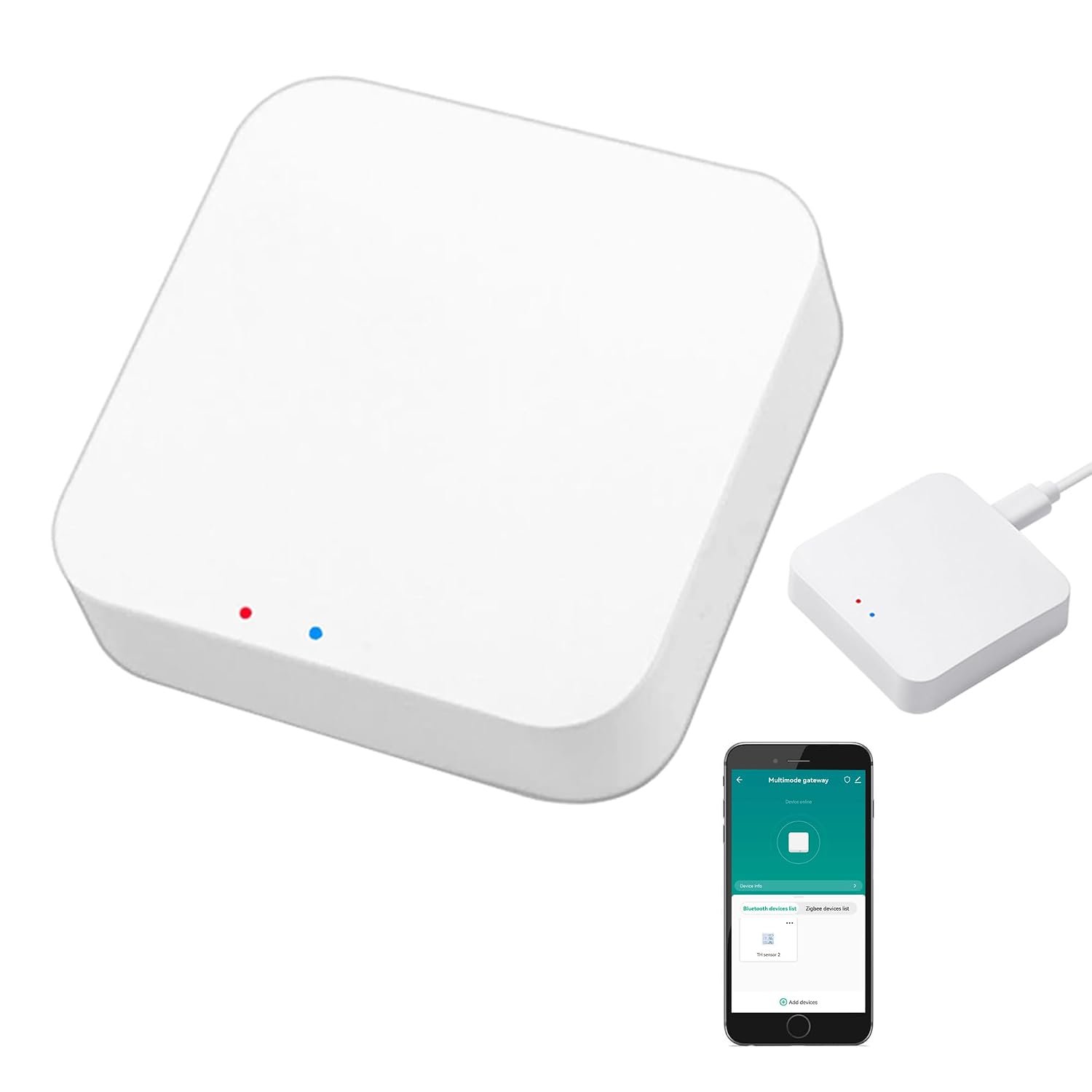
The Smart Multi-Mode Gateway: ZigBee 3.0 & Bluetooth & Mesh Hub, App Remote Control, Intelligent Bridge Wireless Smart Home Gateway Voice Control via Alexa/Google Home is a compact gateway associated with Amazon listing B0D2D89SFQ. The product is identified as a SENCKIT Multi-mode Gateway-1 and is specifically intended for Tuya Smart-compatible devices. Available product documentation identifies Zigbee and Wi-Fi connectivity, while the product description also references Bluetooth Mesh and control through Tuya Smart or Smart Life.
The gateway’s most important characteristic is therefore not simply that it is a smart-home hub. Its purpose is to bridge compatible devices using different communication methods and make them manageable through a common software environment.
Tuya describes its multi-mode gateway architecture as supporting Wi-Fi together with Bluetooth and Zigbee, allowing compatible sub-devices to be viewed and controlled through its app ecosystem. Tuya also describes local device control, group control, automation, and remote management as possible functions of this type of gateway.
At the same time, compatibility needs careful attention. The product title explicitly limits the gateway to Tuya Smart devices. A Zigbee or Bluetooth device is not automatically compatible merely because it uses the same wireless protocol. Brand ecosystem, device certification, firmware, and Tuya support can all matter.
This guide explains how the gateway works, what its different protocols mean, how it can be used in a smart home, what limitations to consider, and how it compares with other types of smart-home hubs.
Key Features
Multi-protocol smart home communication
The main purpose of this gateway is to bring several communication technologies into one smart-home environment.
The product is marketed around Zigbee 3.0, Bluetooth, and Bluetooth Mesh, with Wi-Fi used as the connection between the gateway and the home network. Tuya’s own multi-mode gateway documentation describes this general architecture: Wi-Fi connects the gateway to the cloud and mobile application, while Zigbee and Bluetooth technologies connect compatible sub-devices.
This arrangement can be useful because different smart-home products have different communication requirements.
For example, a small door sensor may be designed around Zigbee, while another accessory may communicate through Bluetooth. A gateway can provide a central bridge without requiring each device to establish a direct Wi-Fi connection.
Zigbee 3.0 support
Zigbee is a low-power wireless communication technology commonly used in smart-home devices.
It is particularly suitable for sensors and other devices that need to communicate efficiently without maintaining the same type of direct Wi-Fi connection used by a smartphone or laptop.
Tuya describes its multi-mode gateway architecture as using the Zigbee 3.0 standard for compatible Zigbee devices.
A Zigbee device typically communicates with the gateway rather than connecting directly to the household Wi-Fi network.
This can help organize a smart-home system around a dedicated hub.
Bluetooth and Bluetooth Mesh
Bluetooth provides another communication pathway for compatible smart-home products.
The product description references Bluetooth Mesh, which is different from ordinary point-to-point Bluetooth connections.
A mesh architecture can allow compatible devices to participate in a network in which messages can be relayed through other participating nodes, depending on the device and implementation.
Tuya’s documentation identifies Bluetooth SIG Mesh as part of its multi-mode gateway ecosystem.
This can be useful when multiple compatible Bluetooth devices need to participate in a broader smart-home arrangement.
However, Bluetooth compatibility alone does not guarantee that a device will work with this gateway. The product is specifically intended for compatible Tuya devices, so users should check the exact device before assuming that any Bluetooth accessory can be added.
Wi-Fi connection
Although the gateway is designed to bridge Zigbee and Bluetooth devices, it still needs a connection to the home network.
The available user-manual information for this specific model identifies 2.4 GHz Wi-Fi using 802.11b/g/n and a 5V/1A power input.
The 2.4 GHz requirement is worth noting because some routers use separate network names for 2.4 GHz and 5 GHz bands.
If a phone is connected to a 5 GHz-only network during setup, the gateway may not be discovered as expected.
Checking the router configuration before installation can prevent unnecessary troubleshooting.
Tuya Smart and Smart Life ecosystem
The gateway is designed around the Tuya ecosystem.
Tuya’s multi-mode gateway documentation explains that compatible Zigbee and Bluetooth devices can be viewed and remotely controlled through the application environment.
The specific product listing also emphasizes that it supports Tuya Smart devices only.
This is one of the most important details to understand.
“Zigbee compatible” does not mean “compatible with every Zigbee product.”
The same principle applies to Bluetooth. The gateway is intended for supported devices within the relevant Tuya ecosystem.
App-based remote control
Once compatible devices are connected through the gateway and configured in the appropriate app, the gateway can provide a bridge between those devices and remote app control.
Tuya describes its multi-mode gateway solution as supporting remote control of connected Bluetooth and Zigbee devices through a mobile phone.
This can be useful when a smart-home device needs to be controlled while the user is away from the house.
For example, a user might check a compatible smart light, adjust a supported switch, or interact with another connected device without being physically next to it.
Remote functionality depends on the gateway’s network connection, the relevant cloud service, the app, and the individual device.
Voice assistant integration
The product description references compatibility with Amazon Alexa and Google Home.
Voice integration can allow compatible Tuya devices to be controlled through supported voice assistants after the appropriate accounts and services have been connected.
This can turn individual devices into part of a voice-controlled routine.
For example, compatible lights could be grouped into a room and controlled through a voice command, subject to the capabilities of the particular devices and the connected voice assistant.
The gateway does not make every connected device automatically voice-controlled. Voice functionality depends on whether the individual device exposes compatible functions through the relevant ecosystem.
Compact physical design
The available specification data identifies the device as a compact unit measuring approximately 60 × 60 × 14 mm. The same documentation identifies a weight of approximately 41 grams and an ABS housing.
A small gateway can be easier to position near a router, power source, or central area of a home.
Placement still matters, however. A gateway that needs to communicate with Zigbee or Bluetooth devices should not simply be placed wherever there is an available power outlet.
The physical layout of the home can influence wireless performance.
USB-powered operation
Available product documentation identifies a DC 5V/1A power input and lists a USB power supply cable among the included components.
This gives the gateway flexibility in terms of where it can be powered, assuming an appropriate power adapter or USB power source is available.
The supplied package information identifies the gateway, USB power supply line, and user manual.
Users should check the current Amazon listing to confirm the exact contents of the package they are purchasing.
How It Can Be Used
Connecting Zigbee smart devices
One of the most common uses is connecting compatible Zigbee devices to a centralized smart-home environment.
A household might use Zigbee for:
- Door sensors
- Motion sensors
- Smart switches
- Smart bulbs
- Temperature sensors
- Smart plugs
- Other supported Tuya accessories
Instead of each device communicating independently with the router, the gateway acts as the central connection point.
Tuya describes its multi-mode gateway architecture as supporting device addition, remote control, group control, and automation for compatible Zigbee and Bluetooth devices.
Connecting compatible Bluetooth devices
The gateway can also provide a central bridge for compatible Tuya Bluetooth devices.
This can be useful when a smart-home device normally depends on Bluetooth communication but needs to participate in a broader home automation system.
Rather than requiring the user’s phone to remain physically close to the device, the gateway can provide the persistent bridge between the Bluetooth device and the smart-home network.
Creating lighting routines
Smart lighting is one of the simplest examples of gateway-based automation.
A user might have several compatible lights in different rooms and configure scenes through the Tuya environment.
For example, a “Night” scene could be configured to reduce or switch off selected lights.
A “Leaving Home” scene could turn off compatible lighting and other connected devices.
The actual automation options depend on the capabilities of the individual devices.
Managing sensors
Sensors are particularly suitable for hub-based smart homes.
A compatible door sensor could be used as a trigger for another device. For example, opening a door could trigger a light, notification, or another automation if the connected products and Tuya software support that relationship.
Tuya describes local linkage, scenario automation, and group control as functions supported by its multi-mode gateway architecture.
Home security scenarios
A gateway can serve as the central connection point for compatible security-related devices.
Possible examples include:
- Door and window sensors
- Motion sensors
- Smart alarms
- Smart lighting
- Compatible switches
- Other Tuya security accessories
A simple automation might activate selected lights when motion is detected.
Another could send a notification when a door sensor changes state.
These examples depend on the exact devices and the automation functions exposed by the Tuya platform.
Smart plugs and appliances
Compatible smart plugs can also become part of a centralized system.
A user could create a routine around a lamp, fan, humidifier, or other compatible appliance.
For example, a smart plug connected to a suitable appliance might be scheduled to switch on at a particular time.
The gateway itself does not make an ordinary appliance smart. The appliance needs to be connected through a compatible smart plug or another supported controller.
Voice-controlled rooms
Once compatible Tuya devices are linked to Alexa or Google Home, users can organize them into rooms or groups supported by the voice platform.
This can make common tasks more convenient.
For example, several compatible lights might be grouped under a room name so that a single voice command controls them together.
The exact voice commands and supported functions vary by device.
Remote access while away
One of the advantages of connecting compatible devices through a gateway is the possibility of remote app control.
A homeowner could use the app to check or control supported devices while away from the house, assuming the gateway and internet connection are operating normally.
This can be useful for situations such as:
- Checking whether lights are on
- Turning off a compatible smart plug
- Activating a lighting scene
- Adjusting supported smart-home devices
- Checking the status of certain sensors
Remote access should not be treated as guaranteed. Internet outages, router problems, cloud-service interruptions, or device connectivity issues can affect availability.
Who It May Be Suitable For
Tuya Smart users
The gateway is most directly relevant to people already using Tuya Smart or Smart Life-compatible devices.
Because the product is specifically limited to Tuya-compatible devices, users who already have a collection of such products may find the gateway easier to integrate into their existing setup.
People building a mixed-protocol smart home
A household may gradually accumulate devices using different wireless technologies.
A multi-mode gateway can provide a central bridge between supported Zigbee and Bluetooth devices while connecting to the home network over Wi-Fi.
This can make a growing system easier to organize.
Smart-home beginners
Someone starting with smart-home automation may prefer a centralized architecture instead of connecting every accessory independently.
A gateway can provide a clear structure:
Smart devices → Gateway → Home network → App
This can make the overall system easier to understand.
Users interested in automation
People who want devices to respond to conditions or schedules can use a gateway as part of an automation system.
Examples include motion-triggered lights, door-triggered scenes, scheduled devices, and grouped controls.
The exact possibilities depend on the devices connected.
Alexa and Google Home users
People already using compatible Amazon Alexa or Google Home setups may appreciate the possibility of bringing supported Tuya devices into their existing voice-control environment.
Users with limited Wi-Fi device capacity
A gateway architecture can reduce the number of individual smart-home accessories that need to connect directly to the Wi-Fi network.
Tuya describes multi-mode gateway systems as allowing Zigbee and Bluetooth devices to communicate through the gateway rather than requiring each device to connect independently to Wi-Fi.
This can be useful in a larger smart-home installation.
Important Things to Consider
Tuya compatibility is the biggest limitation
The product title explicitly says ONLY Support Tuya Smart Devices.
This should be treated as a major compatibility requirement.
A device using Zigbee 3.0 is not automatically guaranteed to work with this gateway.
The same is true for Bluetooth Mesh.
Before purchasing, check whether the specific device you want to connect is listed as compatible with Tuya Smart or Smart Life and whether the manufacturer identifies the required gateway support.
Zigbee is not the same as universal compatibility
Zigbee is a communication standard, but smart-home ecosystems can implement device support differently.
Two Zigbee devices may use the same underlying protocol while offering different compatibility depending on the hub and software ecosystem.
This is why checking the exact device model matters.
2.4 GHz Wi-Fi requirement
The available manual information identifies 2.4 GHz 802.11b/g/n Wi-Fi for this model.
Modern routers often provide both 2.4 GHz and 5 GHz networks.
If setup fails, checking whether the phone and gateway are using a compatible 2.4 GHz network can be an important troubleshooting step.
Internet access and cloud services
A smart gateway can provide local communication between devices, but many remote-control features rely on internet connectivity and cloud services.
Tuya describes both local linkage and cloud-based remote control in its gateway ecosystem.
This distinction matters.
A local automation may continue to function in some circumstances without internet access, depending on the specific gateway and configuration. Remote app control generally requires a working internet connection.
Users should not assume that every feature remains available during an internet outage.
Gateway placement
The gateway should be placed in a location that provides suitable wireless coverage to the connected devices.
Placing it inside a metal cabinet, behind large appliances, or in a distant corner of the house can reduce wireless performance.
A central position may be useful when devices are distributed throughout several rooms.
However, the best location depends on the layout and construction of the home.
Range varies by building
Wireless range is influenced by:
- Walls
- Floors
- Metal structures
- Concrete
- Furniture
- Electrical interference
- Device placement
- Antenna design
A range that works well in an open apartment may not work identically in a large multi-floor house.
Mesh does not mean unlimited range
Bluetooth Mesh and Zigbee mesh networks can extend communication through participating devices, but not every device necessarily acts as a router.
Battery-powered sensors often have different networking behavior from mains-powered devices.
The actual topology therefore depends on the connected devices.
Power interruptions
Because the gateway requires external power, a power outage can affect the system.
Smart devices with their own batteries may remain active, but their connection to the gateway can be interrupted.
For critical security applications, users should understand exactly what happens to their system during a power or internet outage.
Voice assistant limitations
Alexa and Google Home integration can make smart-home control more convenient, but it does not automatically expose every function of every Tuya device.
One product may support on/off voice commands, while another may expose brightness, temperature, mode, or other functions.
The capabilities depend on the device’s integration.
Security matters
A smart-home gateway sits at the center of multiple connected devices, making account security important.
Users should:
- Use a strong account password
- Avoid sharing account credentials
- Keep the app and compatible devices updated
- Review connected devices periodically
- Remove devices that are no longer used
- Use secure Wi-Fi settings
Tuya also provides OTA update capabilities within its gateway ecosystem, allowing supported gateway systems and modules to receive software updates.
The availability and timing of updates for a specific third-party gateway can vary.
Understanding the Smart Home Architecture
A useful way to understand this product is to think of the gateway as a translator and coordinator.
A simplified system can look like this:
Zigbee devices
↓
Multi-Mode Gateway
↓
2.4 GHz Wi-Fi
↓
Tuya Smart / Smart Life ecosystem
↓
Smartphone or compatible voice assistant
Bluetooth devices can follow a similar path:
Bluetooth / Bluetooth Mesh devices
↓
Multi-Mode Gateway
↓
Wi-Fi network
↓
Tuya platform
This architecture separates device-level wireless communication from the home’s primary internet connection.
The gateway therefore does more than simply provide another Wi-Fi access point.
Comparison of General Smart Home Hub Categories
Basic Wi-Fi smart-home devices
Some smart devices connect directly to the home’s Wi-Fi router.
The advantage is simplicity: no separate hub may be required.
However, if a household adds many Wi-Fi devices, the number of connected clients can grow considerably.
Wi-Fi devices may also consume more power than low-power protocols in certain applications.
Single-protocol Zigbee hubs
A Zigbee hub focuses primarily on Zigbee devices.
This can work well for a household built almost entirely around Zigbee.
The limitation is that Bluetooth devices may require another gateway or bridge.
A multi-mode gateway is designed to combine multiple supported protocols in one device.
Bluetooth gateways
Bluetooth gateways focus on Bluetooth-based accessories.
They can be useful when a household has a large number of Bluetooth devices.
However, they may not provide the same Zigbee support as a multi-mode gateway.
Multi-mode gateways
A multi-mode gateway combines several communication technologies.
The specific product discussed here brings together Tuya-compatible Zigbee and Bluetooth-related devices while using Wi-Fi as the network connection.
This can simplify a mixed-protocol smart home.
The trade-off is that compatibility becomes more complex because users must consider both the wireless protocol and the supported ecosystem.
Proprietary ecosystem hubs
Some smart-home brands build their own dedicated ecosystems.
These can provide tightly integrated hardware and software experiences.
The disadvantage is that users may become more dependent on that particular ecosystem.
The Tuya approach can offer access to products from multiple Tuya-compatible manufacturers, but compatibility still needs to be verified at the individual device level.
Advanced smart-home controllers
More advanced users may use platforms designed around extensive automation, local processing, custom integrations, or multiple protocols.
These systems can provide greater configuration flexibility but may require more technical knowledge.
A Tuya-oriented gateway is generally more focused on straightforward ecosystem integration through the Tuya application environment.
Setting Up the Gateway
The exact setup procedure can vary depending on firmware and application versions, but the general process is straightforward.
Prepare the network
Before starting, confirm that the home router has a functioning 2.4 GHz Wi-Fi network.
The available manual information identifies 2.4 GHz 802.11b/g/n as the Wi-Fi standard for the B0D2D89SFQ model.
Install the Tuya application
The gateway is designed to work with the Tuya Smart ecosystem, with product documentation and related Tuya gateway documentation referencing Tuya Smart and Smart Life.
Use the current version of the appropriate application rather than relying on an old setup guide.
Power the gateway
Connect the gateway to its required power source.
The available manual information identifies a 5V/1A input.
Allow the device to enter its setup or pairing state according to the supplied instructions.
Add the gateway to the app
Use the app’s device-add process to discover and configure the gateway.
If discovery fails, check Wi-Fi band settings, phone permissions, Bluetooth settings where required, and whether the gateway is in pairing mode.
Add compatible devices
Once the gateway is configured, compatible Zigbee and Bluetooth devices can be added through the appropriate app workflow.
The exact procedure depends on the device being added.
A smart bulb and a door sensor may have different pairing procedures even though both communicate through the same general ecosystem.
Configure scenes and automations
After devices are added, users can create groups, scenes, schedules, or automations supported by the platform.
Start with simple routines before building complex chains.
A basic lighting automation is easier to troubleshoot than a scene involving multiple sensors, switches, plugs, and voice-assistant integrations.
Practical Smart Home Examples
Evening lighting
A motion sensor could trigger a compatible hallway light during selected nighttime hours.
The sensor and light would need to be compatible with the gateway and automation system.
Leaving-home scene
A user could configure a scene that switches off selected lights and smart plugs when leaving home.
This reduces the need to control each device individually.
Bedroom routine
A scheduled scene could turn off selected lights at bedtime and activate compatible devices according to the user’s routine.
The actual devices and automation capabilities determine what can be included.
Entry notification
A compatible door sensor could trigger a smartphone notification when a door opens.
The exact behavior depends on the sensor, app, and configured automation.
Voice-controlled lighting
After connecting the Tuya ecosystem to Alexa or Google Home, compatible lights can potentially be controlled by voice.
This can be particularly useful when hands are occupied or when controlling several lights together.
Frequently Asked Questions
What is the Smart Multi-Mode Gateway B0D2D89SFQ?
It is a compact smart-home gateway designed to connect compatible Tuya devices using technologies such as Zigbee and Bluetooth-related communication while using Wi-Fi to connect the gateway to the home network. The identified manufacturer is SENCKIT and the model is Multi-mode Gateway-1.
Does it support Zigbee 3.0?
Yes. The product is specifically marketed around Zigbee 3.0, and Tuya’s multi-mode gateway architecture uses Zigbee 3.0 for compatible sub-devices.
Does it support Bluetooth Mesh?
The product description identifies Bluetooth Mesh support, and Tuya’s multi-mode gateway documentation describes Bluetooth SIG Mesh within its compatible gateway architecture.
Does it work with any Zigbee device?
No. The product is explicitly described as supporting Tuya Smart devices only.
A Zigbee device should be verified for Tuya compatibility before purchase.
Does it require Wi-Fi?
The gateway uses Wi-Fi to connect to the home network. Available documentation for this specific model identifies 2.4 GHz 802.11b/g/n Wi-Fi.
Does it support 5 GHz Wi-Fi?
The available manual information specifies 2.4 GHz Wi-Fi. Users should therefore plan to use a compatible 2.4 GHz network during setup rather than assuming 5 GHz support.
Can it work with Alexa?
The product description references Alexa compatibility for voice control of compatible Tuya smart-home devices.
The exact commands and functions depend on the individual connected device.
Can it work with Google Home?
The product description also references Google Home compatibility.
As with Alexa, the available controls depend on the connected device and integration.
Does it work without an internet connection?
Some local automation functions may continue to operate depending on the gateway and configuration. However, remote app control generally depends on a functioning network and cloud connection.
Tuya describes both local linkage and remote control capabilities in its multi-mode gateway architecture.
Users should not assume that every function will remain available during an internet outage.
Can I control the gateway from my phone?
The gateway is designed to be managed through the Tuya Smart ecosystem, with product documentation describing app-based control and management.
How large is the gateway?
Available product documentation identifies dimensions of approximately 60 × 60 × 14 mm and a weight of approximately 41 grams.
What power does it use?
Available documentation identifies a DC 5V/1A input.
What comes in the package?
Available specification information identifies a Zigbee/Bluetooth hub, USB power supply line, and user manual.
The current Amazon listing should be checked for the exact package contents.
Is this gateway useful for a large smart home?
It can be useful for a growing Tuya-based smart-home system, particularly when compatible Zigbee and Bluetooth devices are involved. However, the practical capacity and wireless coverage depend on the gateway, device types, home layout, and software configuration.
Tuya’s broader multi-mode gateway solution documentation describes support for substantial numbers of Zigbee and Bluetooth devices, but those figures should not automatically be assumed to apply to this particular third-party model.
Can I use it with non-Tuya smart devices?
The product listing specifically says it supports Tuya Smart devices only.
Users with devices outside the Tuya ecosystem should verify compatibility before attempting to build a system around this gateway.
Conclusion
The Smart Multi-Mode Gateway B0D2D89SFQ is designed to serve as a central bridge for compatible Tuya smart-home devices using different wireless technologies.
Its primary role is to connect supported Zigbee and Bluetooth-related devices to a Wi-Fi-based home network and make them manageable through the Tuya ecosystem. Tuya’s multi-mode architecture is built around this concept, combining Wi-Fi with Zigbee and Bluetooth communication to support centralized device management, remote control, group functions, and automation.
The gateway can be useful in several types of smart-home installations. It can connect sensors, switches, lights, smart plugs, and other compatible accessories while providing a centralized point for app-based management. With supported integrations, users can also bring compatible devices into Alexa or Google Home voice-control environments.
Its compact physical design, identified at approximately 60 × 60 × 14 mm, allows it to occupy relatively little space, while the documented 2.4 GHz Wi-Fi connection provides the network link between the gateway and the home environment.
The most important consideration, however, is compatibility. This is not a universal Zigbee or Bluetooth hub. The product specifically states that it supports Tuya Smart devices only. A device using Zigbee or Bluetooth does not automatically become compatible simply because it uses the same underlying wireless technology.
For someone building or expanding a Tuya-based smart home, a multi-mode gateway can provide a useful central architecture for managing compatible devices. For someone using several unrelated smart-home ecosystems, compatibility should be investigated carefully before making the gateway the foundation of the installation.
The best approach is to identify the exact devices you intend to connect, verify their Tuya compatibility, confirm the 2.4 GHz network requirement, choose an appropriate gateway location, and then build automation gradually. With those considerations in place, a multi-mode gateway can serve as the communication bridge between everyday smart-home accessories and a centralized control environment.
Leave a Reply