Introduction
Smart home systems often begin with a simple idea: connect a few devices so they can be monitored or controlled from a phone. A smart plug may control a lamp, a sensor may report when a door opens, or a leak detector may send an alert when water is detected. As the number of connected devices grows, however, the communication method used by those devices becomes increasingly important.
Many smart-home products depend on Wi-Fi or Bluetooth. These technologies can work very well in many homes, but range, battery consumption, building materials, and network congestion can become considerations when devices are installed in garages, sheds, basements, outbuildings, utility areas, or other locations far from a router.
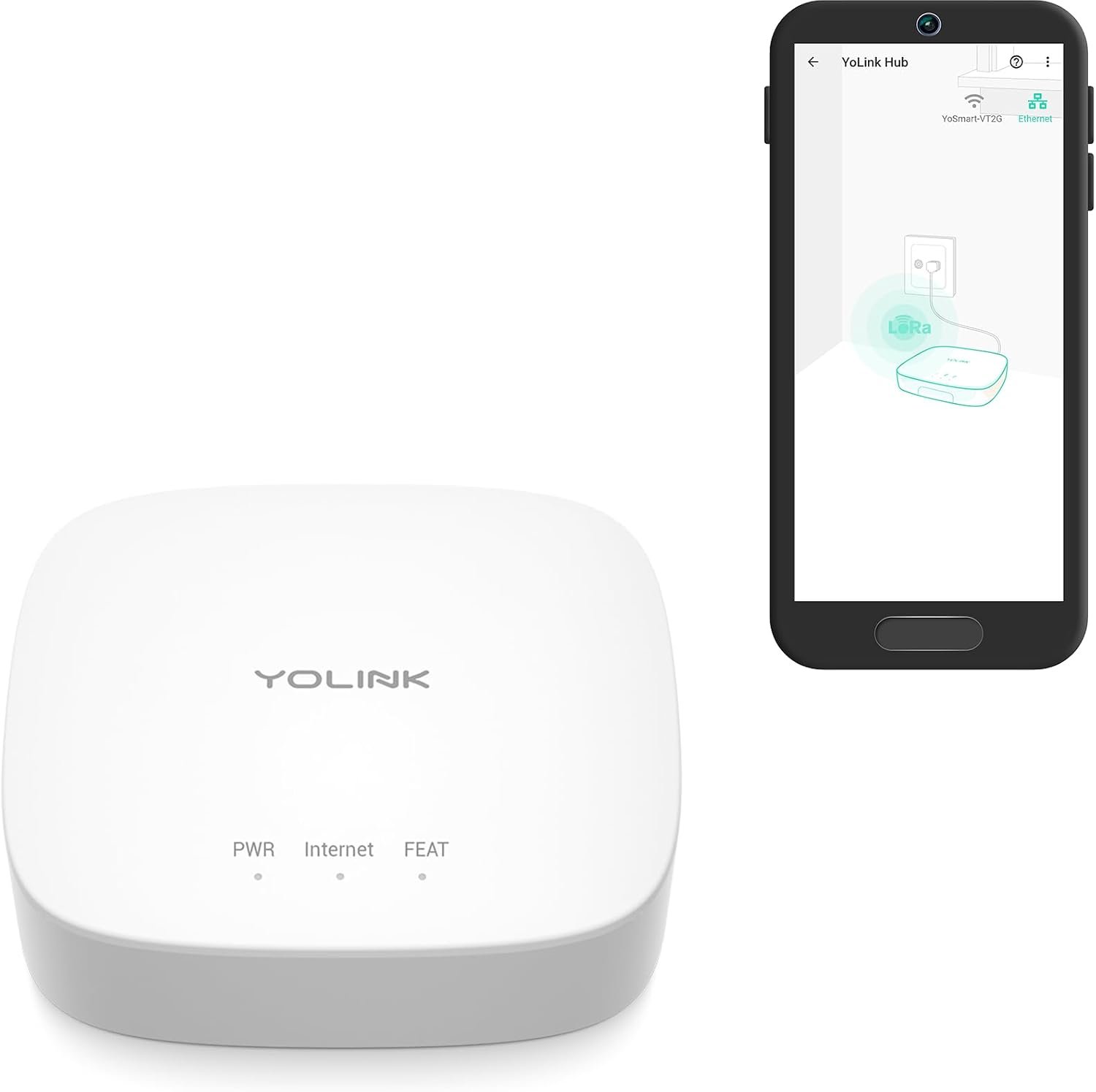
The YoLink Smart Home Hub YS1603 takes a different approach by serving as the central gateway for YoLink’s low-power, long-range smart-home ecosystem. The hub connects compatible YoLink devices to the internet and provides a bridge between the local YoLink network and cloud-based services. YoLink describes its system as using LoRa-based technology for long-range communication and low-power operation.
This architecture can be particularly relevant for households that want to monitor locations where traditional Wi-Fi-based sensors may not be ideal.
The YS1603 is not simply a universal smart-home hub that automatically supports every Zigbee, Z-Wave, Bluetooth, or Wi-Fi device. Instead, it belongs to the YoLink ecosystem, meaning that compatibility with specific YoLink sensors, switches, locks, alarms, and other accessories is central to how the system works.
YoLink documentation describes the hub as an internet gateway for YoLink devices, while the company explains that the hub communicates with individual devices using LoRa technology and then connects to the internet through Ethernet or Wi-Fi, depending on the hub model and configuration.
Understanding that architecture helps explain where a hub such as the YS1603 fits into a smart-home installation.
This article explores the hub’s role, the communication technology behind it, potential applications, installation considerations, ecosystem compatibility, and the differences between a dedicated LoRa-based smart-home hub and other common hub categories.
Key Features
Central gateway for YoLink devices
The primary purpose of the YS1603 is to act as a gateway between compatible YoLink devices and the internet.
Instead of every sensor needing its own direct internet connection, devices communicate with the hub. The hub then provides the connection between the local YoLink network and YoLink’s online services.
This architecture can be particularly useful for battery-powered sensors because the individual devices do not need to maintain a continuous Wi-Fi connection.
YoLink describes the hub as a central component of its smart-home system and explains that it connects YoLink devices to the internet for remote monitoring and automation.
LoRa-based long-range communication
One of the defining characteristics of the YoLink ecosystem is its use of LoRa, short for Long Range.
LoRa is designed for long-distance, low-power wireless communication. Rather than prioritizing high data throughput like Wi-Fi, it focuses on sending relatively small amounts of information efficiently over longer distances.
That makes the technology well suited to smart-home sensors.
A temperature sensor, door sensor, water-leak detector, or motion sensor usually does not need to stream video or transfer large files. It may simply need to send a small status update such as “door open,” “temperature 68°F,” or “water detected.”
YoLink explains that its devices use LoRa-based communication to provide long range and low power consumption.
Designed for low-power devices
Many smart-home sensors are battery powered.
A Wi-Fi connection can provide high bandwidth, but maintaining Wi-Fi connectivity can require more energy than the simple data communication needed by a sensor.
The YoLink architecture is designed around low-power communication.
This can make it suitable for devices that need to operate for long periods without frequent battery changes.
Battery life still depends on the specific YoLink device, its settings, environmental conditions, transmission frequency, and battery quality. The hub itself is continuously powered, while the individual sensors can use their own batteries.
Internet connectivity
The hub provides the bridge from YoLink devices to the wider internet.
This allows compatible devices to be monitored and controlled through the YoLink application and supported services when the required internet connection is available.
The exact networking method depends on the specific hub model and current documentation. YoLink’s documentation distinguishes between hub models and explains the available network connection options.
Users should therefore follow the instructions for the exact YS1603 hardware rather than assuming that every YoLink hub has identical networking capabilities.
Mobile app integration
The hub works as part of the YoLink mobile ecosystem.
The app can be used to configure compatible devices, view status information, create automations, and receive notifications depending on the device and service.
This is particularly useful when a sensor is installed somewhere the user cannot easily check in person.
For example, a water sensor under a sink can report a problem through the app instead of requiring someone to physically inspect the area.
Support for multiple types of sensors and devices
The YoLink ecosystem includes different categories of smart-home devices.
Depending on the specific product and current compatibility list, users can build systems around devices such as:
- Door and window sensors
- Water-leak sensors
- Temperature and humidity sensors
- Motion sensors
- Smart plugs
- Light controls
- Garage door controllers
- Valve controls
- Locks
- Alarms
- Outdoor monitoring devices
The important point is that these devices are part of the YoLink ecosystem. The YS1603 should not be interpreted as a universal gateway for unrelated smart-home products.
Automation support
A hub becomes considerably more useful when it can connect events to actions.
For example, a water sensor could trigger a notification, or a door sensor could initiate an automation involving another compatible YoLink device.
YoLink’s platform supports device automation and scenes, although the available actions depend on the specific devices involved.
This allows users to move beyond simple remote control and create event-based smart-home behavior.
Remote monitoring
One of the practical reasons to use a hub is the ability to check devices remotely.
A user might want to know whether a garage door is closed, whether a basement sensor has detected water, or whether a remote temperature sensor has exceeded a threshold.
The hub provides the connection between those local devices and the online service that allows remote access.
Remote monitoring naturally depends on power, internet connectivity, hub availability, and the status of the individual sensor.
Understanding YoLink’s Communication Architecture
Hub versus sensor
It helps to separate the roles of the hub and the sensor.
A YoLink sensor is normally installed where information needs to be collected.
The hub stays in a suitable location where it can communicate with the sensors while maintaining its internet connection.
The sensor might be installed in a basement, garage, shed, mailbox, or utility room. It sends its data through the YoLink network to the hub.
The hub then communicates with the online platform.
This is different from a simple Wi-Fi sensor that communicates directly with a wireless router.
Why low data requirements matter
Smart-home sensors generally transmit small amounts of data.
A water sensor might report:
Normal → Water detected
A door sensor might report:
Closed → Open
A temperature sensor might report:
72°F → 75°F
These small messages do not require high-speed networking.
This is where low-power, long-range technologies such as LoRa can be particularly appropriate.
Long range is not unlimited range
The term “long range” should not be interpreted as a guarantee that a device will work at any distance.
Wireless performance depends on:
- Building materials
- Terrain
- Elevation
- Walls
- Metal structures
- Vegetation
- Interference
- Device placement
- Antenna orientation
- Local radio conditions
YoLink publishes long-range claims for its ecosystem, but real-world performance can vary according to the environment.
A sensor inside a metal structure or underground location can behave differently from one installed in an open area.
One hub can support multiple devices
A central hub allows multiple compatible devices to share the same gateway.
This is useful for expanding a smart-home system over time.
Instead of buying a separate internet gateway for every sensor, users can build a collection of compatible devices around the existing YoLink hub, subject to the platform’s device limits and compatibility requirements.
The practical capacity depends on the hub, firmware, account, and current YoLink specifications.
How It Can Be Used
Monitoring a basement
Basements are a natural application for remote sensors.
A water-leak sensor can be placed near a water heater, sump pump, washing machine, or other potential source of water.
The sensor communicates with the YoLink hub, allowing the user to receive an alert if water is detected.
This can be particularly useful because a basement may be unoccupied for long periods.
Garage monitoring
A garage can be separated from the main living area by walls or other structures that make some wireless technologies less convenient.
Compatible YoLink sensors can monitor the garage door, temperature, motion, or other conditions.
A user could receive an alert if a monitored door changes state or if a temperature sensor reaches a configured threshold.
Monitoring an outdoor shed
A shed may be too far from the home router for reliable Wi-Fi connectivity.
A low-power long-range ecosystem can provide another approach.
A compatible door sensor could report whether the shed is open or closed, while another sensor could monitor environmental conditions.
The actual range should always be tested at the intended installation location rather than assumed from a specification.
Monitoring a mailbox
A mailbox can be another interesting use case.
A compatible sensor could notify a homeowner when the mailbox door is opened.
Because the sensor may be installed away from the house, long-range communication can be useful.
The physical environment matters, especially if the mailbox is metal.
Water-leak detection
Water leaks can cause damage before someone notices them visually.
A YoLink water sensor connected through the hub can provide an alert when water is detected.
Potential locations include:
- Under sinks
- Near water heaters
- Around washing machines
- Near sump pumps
- In utility rooms
- Near refrigerators with water connections
The sensor is not a substitute for plumbing maintenance or physical inspection, but it can provide another layer of awareness.
Temperature monitoring
Temperature sensors can be useful in areas where conditions need to remain within a particular range.
Examples include:
- Basements
- Garages
- Storage rooms
- Greenhouses
- Vacation properties
- Equipment rooms
The suitability depends on the specifications of the individual sensor.
A gateway can collect information from the sensor and make it available through the smart-home platform.
Monitoring a vacation property
A remotely located property can benefit from centralized sensor monitoring.
Instead of relying on frequent physical inspections, compatible sensors can provide information about doors, water, temperature, and other conditions.
This can be useful for homeowners who travel frequently or own a property that remains empty for extended periods.
Internet connectivity at the property remains necessary for remote cloud-based access.
Garage door status
A smart garage solution can provide information about whether the door is open or closed.
Depending on the compatible YoLink controller and automation configuration, users may be able to receive notifications or control the garage door remotely.
Because garage doors are safety-critical mechanical systems, installation should follow the manufacturer’s requirements and applicable safety practices.
Smart lighting and plugs
The hub can also serve as part of a system involving compatible smart plugs or controls.
For example, a door sensor might trigger a light when a door opens.
A schedule could also control a connected smart plug.
The exact automation depends on the compatible YoLink devices and the functions exposed by the platform.
Who It May Be Suitable For
Homeowners with remote areas
The YS1603 can be relevant to homeowners who want to monitor spaces that are physically distant from the main router.
Garages, sheds, basements, detached buildings, and outdoor areas can present connectivity challenges.
People building a sensor-focused smart home
Users who primarily want sensors rather than high-bandwidth devices may find the low-power architecture particularly relevant.
A sensor network does not need the same bandwidth as cameras or streaming devices.
Vacation-property owners
A hub-based monitoring system can provide another way to keep track of important conditions while away from the property.
Door status, water detection, and temperature are examples of information that can be useful remotely.
Users who want fewer Wi-Fi sensors
Some people prefer not to put every sensor directly on the household Wi-Fi network.
A dedicated low-power ecosystem separates many sensors from the primary Wi-Fi environment while still providing internet-connected functionality through the hub.
DIY smart-home builders
The YoLink system can be expanded gradually.
A user can start with one or two sensors and add other compatible devices as needs develop.
This approach can be easier to manage than installing a large number of devices simultaneously.
Important Things to Consider
It is not a universal smart-home hub
This is one of the most important points.
The YS1603 is designed for the YoLink ecosystem.
It does not automatically replace every Zigbee, Z-Wave, Matter, Thread, Bluetooth, or Wi-Fi hub.
Before purchasing, identify the devices you intend to use and confirm that they are supported by YoLink.
YoLink ecosystem dependency
Choosing a dedicated hub means building around a particular ecosystem.
This can simplify compatibility within that ecosystem, but it also means users should consider long-term compatibility with future devices.
If a household already owns devices from several unrelated ecosystems, a universal or multi-protocol controller may be a better architectural fit depending on the user’s requirements.
Internet connection requirements
The hub needs a suitable internet connection for cloud-based remote access.
If the internet connection goes down, remote monitoring and control may be unavailable until connectivity is restored.
Some local functions may behave differently depending on the specific device and automation configuration.
Power requirements
Unlike battery-powered sensors, the hub itself requires continuous power.
If the hub loses power, connected devices may no longer have a path to the cloud.
For critical monitoring applications, users may want to consider backup power for the hub and networking equipment.
Wireless environment
Long-range radio technology can perform differently depending on the environment.
Concrete walls, metal structures, underground areas, and other obstacles can affect communication.
Testing the intended installation location before permanently mounting a sensor can help identify connectivity issues.
Metal enclosures
Metal can interfere with radio communication.
This is particularly relevant for applications involving metal sheds, electrical cabinets, metal mailboxes, or other enclosures.
If a sensor is installed inside a metal enclosure, its communication range may be reduced significantly.
Battery life varies by sensor
The hub itself does not determine how long a battery-powered sensor will operate.
Battery life depends on the specific sensor and its environment.
Temperature, transmission frequency, signal conditions, battery chemistry, and usage patterns can all influence battery performance.
Notifications are not a substitute for emergency systems
A smart-home notification system can be useful for awareness, but it should not automatically be treated as a life-safety system.
For fire detection, carbon monoxide protection, medical emergencies, and other high-risk situations, users should rely on properly certified equipment designed for those purposes.
A smart-home hub can complement safety systems but should not replace them unless the specific equipment is explicitly designed and certified for that application.
Automation needs testing
An automation that looks simple on screen can behave differently in the physical environment.
For example, a motion sensor might trigger a light repeatedly if the detection area is not configured properly.
A door sensor might generate notifications at unexpected times if the door is frequently opened.
Testing automations in real-world conditions helps identify these issues.
Comparison of General Smart Home Hub Categories
Wi-Fi-only smart home devices
Wi-Fi devices can connect directly to a home router.
This can make initial installation simple because no dedicated hub is necessary for certain products.
The limitation is that each device depends directly on Wi-Fi coverage and power characteristics.
Battery-powered Wi-Fi sensors can also have different battery-life considerations than low-power alternatives.
Zigbee hubs
Zigbee hubs provide a low-power wireless network for compatible Zigbee devices.
They can be useful for homes built around Zigbee products.
However, users need to verify compatibility between the specific Zigbee device and hub.
Z-Wave hubs
Z-Wave is another established smart-home communication technology.
It is commonly used for switches, sensors, locks, and other home automation devices.
The main difference from YoLink is that Z-Wave operates within its own ecosystem and radio technology.
A Z-Wave device does not automatically work with a YoLink hub.
Matter controllers
Matter is a newer smart-home interoperability standard designed to improve compatibility between supported ecosystems.
Matter-compatible controllers can work with devices from multiple participating platforms.
However, Matter support does not necessarily mean that every legacy device becomes compatible.
A dedicated YoLink ecosystem can remain attractive to users who want access to the specific long-range characteristics and devices offered by YoLink.
Bluetooth gateways
Bluetooth gateways can connect Bluetooth-based devices to the internet.
They can be useful for certain sensors and accessories.
However, ordinary Bluetooth communication is generally more focused on shorter-range applications than the long-range LoRa architecture used by YoLink.
LoRa-based smart-home hubs
LoRa-based systems focus on long-range, low-power communication.
This makes them particularly interesting for sensors installed in remote areas.
The trade-off is ecosystem dependence: users need compatible devices that support the same platform.
Building a YoLink-Based Smart Home
Start with one problem
Rather than installing many devices immediately, it can be useful to identify a specific problem.
For example:
- Basement water detection
- Garage-door monitoring
- Shed security
- Vacation-home temperature monitoring
- Mailbox notifications
Once the initial system works correctly, additional devices can be added.
Choose the appropriate sensor
The hub does not perform the sensing itself.
A water sensor is needed for water detection, a temperature sensor for temperature monitoring, and a door sensor for door status.
Choosing the right sensor is therefore just as important as choosing the hub.
Position the hub strategically
Because the hub communicates with the sensors and the internet, its location matters.
A central area of the property may provide better coverage than a corner of the house.
The ideal location depends on the physical structure and where the sensors will be installed.
Test before permanent installation
Before attaching sensors permanently, place them temporarily in their intended locations.
Check whether the hub receives their status reliably.
This can reveal weak-signal locations before the installation becomes difficult to change.
Build automations gradually
Start with one simple automation.
For example:
Water detected → smartphone notification
Once that works reliably, more complex scenarios can be introduced.
This makes troubleshooting easier.
Privacy and Security Considerations
Connected-home devices generate data about what happens inside and around a property.
Depending on the device, this can include door status, environmental conditions, motion events, or other information.
Users should protect their accounts with strong credentials and use current software versions.
It is also useful to periodically review connected devices and remove equipment that is no longer in use.
Where a smart-home system is shared among household members, access should be provided only to people who need it.
Security is especially important for devices that control physical systems such as doors, locks, garage doors, or appliances.
Frequently Asked Questions
What is the YoLink YS1603?
The YS1603 is a YoLink smart-home hub designed to connect compatible YoLink devices to the internet and provide centralized management through the YoLink ecosystem. YoLink describes its platform as using long-range, low-power LoRa communication between the hub and supported devices.
What wireless technology does YoLink use?
YoLink uses LoRa-based communication for its device network. The technology is designed for long-range, low-power data transmission.
Is YoLink the same as Zigbee?
No. YoLink and Zigbee are different wireless technologies.
A YoLink device should not be assumed to work with a Zigbee hub simply because both systems are designed for smart-home applications.
Does the YS1603 work with Wi-Fi?
The hub connects the YoLink ecosystem to the internet through the supported network connection specified for the particular hub model. Users should follow the current YS1603 documentation for the exact network configuration.
Can it connect to any smart-home device?
No. It is designed primarily for compatible YoLink devices.
A device from another ecosystem should be checked for explicit YoLink compatibility before purchase.
What devices can be used with the hub?
The YoLink ecosystem includes compatible sensors and controllers for areas such as doors, water detection, temperature, motion, lighting, plugs, garage doors, locks, and other monitoring or automation applications.
Compatibility should be checked for the specific device model.
Can YoLink devices be controlled remotely?
The hub provides the internet connection that enables remote monitoring and control through the YoLink platform when the hub, internet connection, and relevant services are operating normally.
Is the hub useful for a detached garage?
Potentially. Long-range communication is one of the characteristics of the YoLink ecosystem, making it relevant to locations that may be difficult to reach with conventional short-range wireless technologies.
Actual performance depends on the distance, building construction, obstacles, and local radio conditions.
Can it be used in a basement?
Yes, when paired with compatible YoLink sensors. Basements can be useful locations for water, temperature, humidity, and other monitoring devices.
The specific sensor must be appropriate for the environment.
Can it monitor a vacation property?
A YoLink-based system can be used for remote monitoring applications where internet connectivity and compatible sensors are available.
Users should consider backup power and internet reliability if monitoring a property that is unoccupied for long periods.
Does the hub require constant power?
Yes. The hub itself is a powered gateway, unlike many of the battery-operated sensors that connect to it.
Will connected sensors work if the internet goes down?
The behavior can vary depending on the device and automation. Cloud-based remote access requires internet connectivity, while some local communication or automation functions may have different behavior.
Users should test important automations rather than assuming how they will behave during an outage.
Is YoLink suitable for battery-powered sensors?
The ecosystem is specifically designed around low-power communication, making battery-powered sensors an important part of the platform.
Actual battery life depends on the individual sensor and operating conditions.
Does long-range communication mean the signal works anywhere?
No. Long-range radio technology still has physical limitations.
Walls, metal, terrain, underground locations, and other obstacles can affect communication.
Can this hub replace a Wi-Fi router?
No. A smart-home hub and Wi-Fi router have different functions.
The router provides network connectivity for the home, while the YoLink hub provides the gateway between compatible YoLink devices and the internet.
Is the YS1603 a universal Matter hub?
It should not be treated as a universal Matter controller.
The YS1603 is part of the YoLink ecosystem and is designed for compatible YoLink products.
Can I use a YoLink sensor without a hub?
The exact requirements depend on the particular YoLink device, but the hub is a central component for connecting many YoLink devices to the internet and enabling remote access.
Check the documentation for the specific sensor before assuming it can operate independently.
Conclusion
The YoLink Smart Home Hub YS1603 is designed around a specific smart-home architecture: use a central gateway to connect compatible low-power, long-range YoLink devices to an internet-connected home environment.
Its most distinctive characteristic is the use of LoRa-based communication. Unlike Wi-Fi, which is designed for much higher data throughput, LoRa focuses on sending relatively small amounts of information over longer distances while supporting low-power devices. This makes the YoLink approach particularly relevant to sensors installed in garages, sheds, basements, outdoor areas, utility spaces, and other locations where conventional Wi-Fi connectivity may be inconvenient.
The hub can form the center of a broader monitoring and automation system. Depending on the compatible devices used, homeowners can monitor doors, water, temperature, motion, garage doors, and other conditions. The YoLink platform can then provide app-based monitoring, notifications, remote access, and automation features.
The most important limitation is also straightforward: the YS1603 is not a universal smart-home hub. It belongs to the YoLink ecosystem, so the devices being connected need to be compatible with YoLink. A Zigbee, Z-Wave, Bluetooth, Matter, or Wi-Fi device from another ecosystem should not be assumed to work simply because it uses a similar wireless concept.
For users already interested in YoLink devices, the YS1603 provides a central communication point around which a larger sensor and automation system can be built. For those considering different smart-home ecosystems, the decision should come down to communication range, power requirements, device compatibility, remote-access needs, automation features, and the long-term ecosystem they want to use.
A sensible installation begins with a specific monitoring problem rather than adding devices without a clear purpose. Identify the area that needs attention, select the appropriate YoLink sensor, place the hub where it can maintain reliable communication, test the connection, and then expand the system gradually.
With that approach, a dedicated long-range smart-home hub can become a useful foundation for monitoring areas that are difficult to reach with conventional short-range wireless solutions.
Leave a Reply